
The heritage tomatoes from the greenhouse
Noire de Crimée, Rose de Berne, Cœur de bœuf… How to grow heritage tomatoes in a greenhouse in a damp climate like ours, prevent blight, save your own seeds and cook the harvest.
- In practice, a “heritage” tomato is an open-pollinated variety : its seeds give the same tomato again, unlike an F1 hybrid.
- In Normandy, sow indoors in the warm from mid-March to early April, and plant out in an unheated greenhouse in late April or early May.
- In a greenhouse, enemy no. 1 is humidity: airing it every day and watering at the base of the plants limit blight.
- Saving your seeds is simple: a few days of fermentation in a jar, thorough drying, and they keep for about 4 to 6 years.
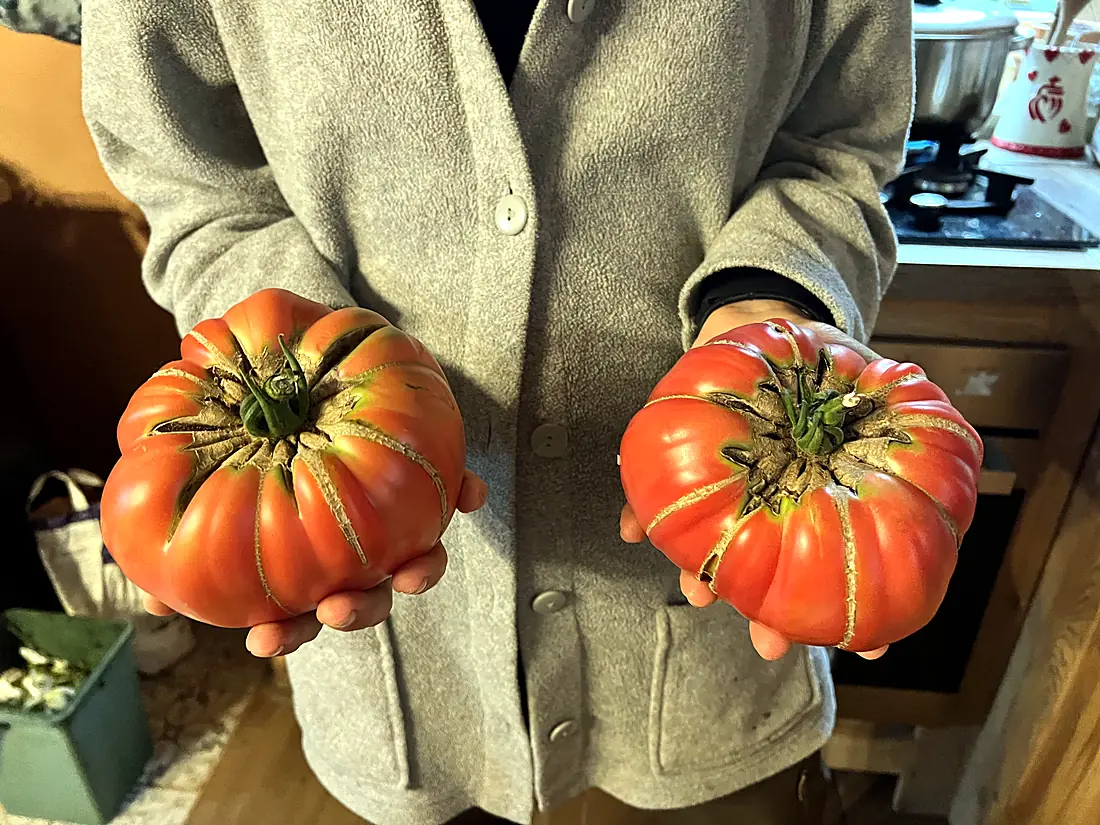
Here on the farm, we have a vegetable garden, a greenhouse and an orchard. Our aim is not to sell, but to work towards food self-sufficiency, with positive ecology: we plant, we observe, we learn. Tomatoes have their rightful place here. Here are the essentials, checked against reliable sources, for growing them successfully in a damp oceanic climate like ours, from seed to jar.
Heritage tomato, open-pollinated variety or F1 hybrid?
There is no official definition of a “heritage tomato”. The term generally refers to open-pollinated varieties: a group of plants that are slightly different from one another, selected by generations of gardeners and farmers. Their great advantage: if you sow their seeds, you get the same tomato the following year.
An F1 hybrid is the first generation of a cross between two pure lines. It is vigorous and very uniform, often with disease resistance. But its seeds do not produce true-to-type plants: in the next generation, the traits separate and the plants become very different. With an F1, you therefore have to buy seed again every year. The words “F1” usually appear on the packet.
Tomatoes are very well suited to home seed saving. The flower carries both male and female organs: it is self-pollinatingand most often fertilises itself. In our temperate climates, crosses between varieties are rare.
What heritage varieties offer, and what they need
The trials carried out by GRAB (Groupe de recherche en agriculture biologique) on dozens of heritage-type varieties, under cover, sum up the picture well: better flavour than modern varieties and an incredible range of shapes and colours, but more fragile fruit, more prone to splitting, often a lower yield and little genetic resistance to disease. In other words: you grow them for the pleasure on your plate, and you take care with prevention.
Six well-known heritage varieties, and their character
Here are some of the open-pollinated varieties best known to gardeners. They are not necessarily the ones in our greenhouse: it is a selection to help you choose.
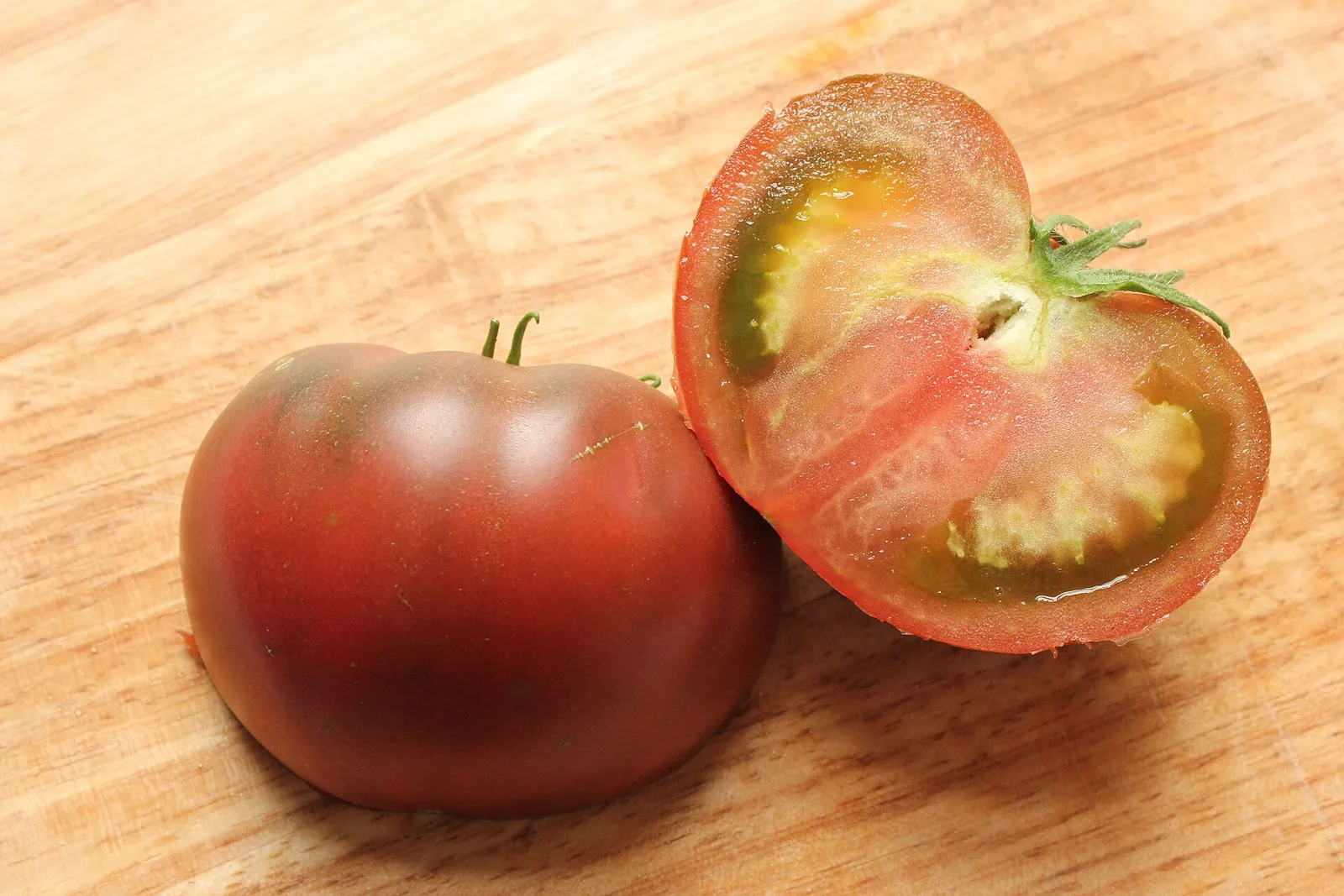
- Noire de Crimée. Originally from Crimea. A flattened fruit of about 250 g, dark red-purple to almost black, often with green shoulders. Indeterminate growth: the plant can reach about 1.80 m in a greenhouse. In the GRAB trials, it is one of the best for flavour, juicy, but prone to splitting.
- Rose de Berne. A round, pink fruit with thin skin. GRAB credits it with a pleasant flavour and very juicy flesh, but also a certain lateness and a fragile skin that splits easily.
- Cœur de bœuf. The real one is a big, fleshy, juicy, heart-shaped fruit. Watch out for “fake” cœur de bœuf of the Albenga type, shaped like a ribbed pear, often sold as F1 hybrids. And some sold as “red” turn out to be pink.
- Marmande. The classic red, flat, ribbed tomato with a green collar. Many selections are sold under this name, including many F1 hybrids: if you want to save your seeds, check the packet carefully.
- Green Zebra. A small, round fruit, green striped with yellow, with a tangy flavour. It is not an old variety: the American Tom Wagner introduced it in 1983. But it is an open-pollinated variety, so you can save its seeds. A very vigorous and rather late plant.
- Cornue des Andes. An elongated, horn-shaped fruit with dense flesh, perfect for sauce. A very vigorous, late plant, susceptible to blossom end rot (the “black bottom”).
Our tip for Normandy: the seasons are shorter and cooler than in the south. Keep the greenhouse space for late or fragile varieties (Rose de Berne, Cornue des Andes, Green Zebra) and choose early varieties if you grow outdoors.
The tomato sowing calendar in Normandy
Tomatoes love warmth. Professional references for western France give ideal germination with air at 18-20 °C and compost at 22-25 °C, with seedlings emerging in 5 to 11 days at 20 °C. For growth, aim for about 20 °C during the day and 13 °C at night. Market gardeners who heat their tunnels plant out from March; in the garden, with an unheated greenhouse, it is better to wait.
- Mid-March to early April: sowing. In the warm, indoors, in a seed tray or small pots, with the seeds covered by a thin layer of compost. Give them the strongest light possible, otherwise the seedlings become leggy.
- One to three weeks after sowing: pricking out. When the seed leaves have fully opened or the first two true leaves appear, each seedling goes into its own pot, in the warm and the light.
- Late April or early May: planting in the greenhouse. The plants should be sturdy, with 4 or 5 leaves, ideally with the first truss of flowers visible. Even under cover, do not plant too early: tomatoes do not like cool nights. In the days before, put the pots outside for a few hours a day to harden them off.
- Outdoors: not before mid-May. And do not blindly trust the Ice Saints (11, 12 and 13 May): a Météo-France study of 130 stations, from 1951 to 2023, shows that in two years out of three at least one lowland station still had frost after 13 May. In May 2010, frosts hit the regions near the Channel, with -1 °C in Caen on 14 May.
- July to October: harvesting. In a greenhouse, the first fruit usually arrives in July, and production continues until the first cold spell.
Caring for tomatoes in a greenhouse
Air, air, air
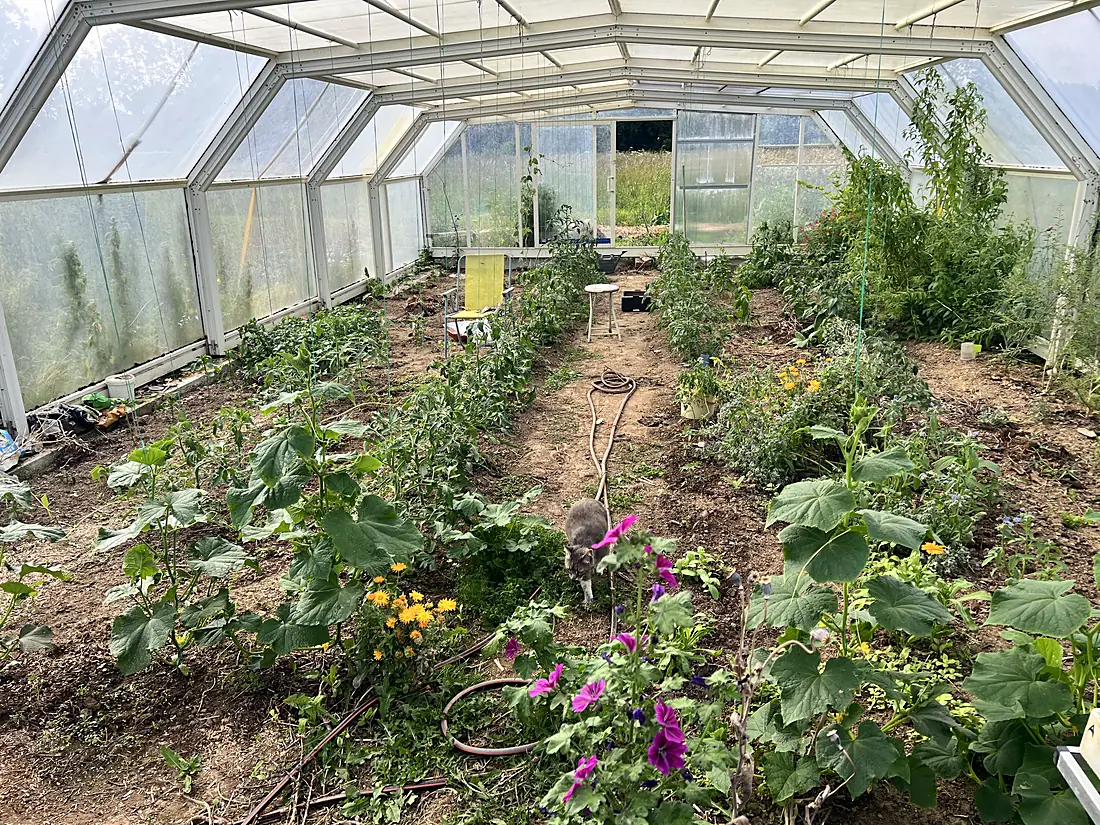
In a Normandy greenhouse, the danger in summer is not the cold, it ishumidity. At night, water condenses on the walls and on the leaves, and that is exactly what diseases love. Open doors and windows as soon as the morning warms up, to drive out this humidity, and leave them wide open in mild weather. The technical guides all agree: air the greenhouse as often as possible.
Water at the base, regularly
Water in the morning, at the base of the plant, without wetting the leaves. Regularity matters more than quantity: soil that dries out and is then flooded causes blossom end rot, that black patch at the end of the fruit, and a lack of water reduces the size of the tomatoes. In market gardening, the rule of thumb is about 1 litre per plant per day in high summer, and 1 litre every three days at the start and end of the season. A mulch (straw, dry grass cuttings, leaves) keeps the soil cool and cuts down on weeding. Professional guides also say you can stop watering around early October to help the last fruit ripen.
Spacing and staking
Do not crowd the plants: at least 30 cm between them, and market gardeners allow 2 to 2.5 plants per square metre. Air needs to circulate. Indeterminate varieties, which means most heritage ones, keep on growing: they need guiding. The simplest method in a greenhouse is a string tied to the frame, around which you wind the stem as it grows. A sturdy stake also does the job.
Side shoots and removing leaves
The side shoots are the shoots that grow where the leaves join the stem. On indeterminate varieties, remove them regularly, while they are still small, to avoid large wounds and to keep one or two stems. Determinate varieties, which stop growing by themselves after a few trusses, need little or no pruning. Also gradually remove the lower leaves, up to the first truss of fruit but no further: air flows better, and leaves touching the ground no longer bring up diseases. About two months before the planned end of the season, pinch out the growing tip two leaves above the last truss: the plant then puts its energy into the fruit already formed.
Move them around
Avoid replanting tomatoes, potatoes, aubergines or peppers in the same place from one year to the next: they are all nightshades, which share the same diseases. The technical guides advise coming back to the same spot every 3 to 4 years. In a small greenhouse, at least alternate sides, and feed the soil well with compost.
Preventing tomato blight
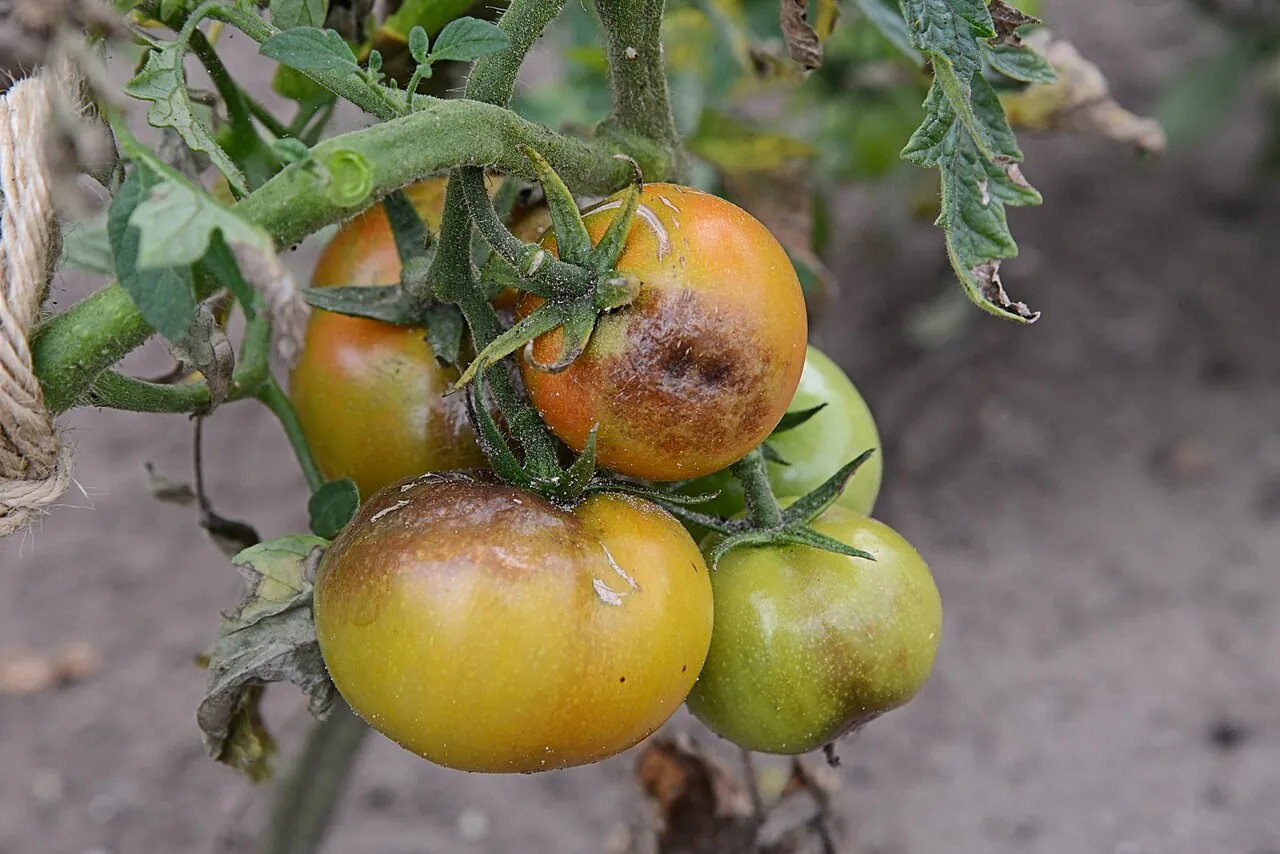
Blight is caused by Phytophthora infestans, a micro-organism long classified as a fungus (it is an oomycete). It is the same one that attacks potatoes. It affects the leaves, stems and fruit, and can destroy a row in a few days.
- The signs: on the leaves, oily-looking, olive-green patches that quickly turn brown, sometimes with a fine white down underneath, most visible in the morning. On the stems, large brown patches. On the fruit, irregular, bumpy brown patches.
- What it likes: prolonged humidity (rain, fog, dew, watering the leaves) and temperatures between 2 and 25 °C. It survives in tomato and potato debris left on the ground, and travels with the rain, the wind and the gardener's hands.
- What holds it back: the greenhouse itself, which protects from the rain, ventilation, watering at the base in the morning, spacing, removing the lower leaves, and not too much nitrogen fertiliser.
- At the first sign: remove the affected leaves straight away, without putting them on the compost (sealed bag, recycling centre). If the plant is badly affected, pull it out entirely.
Do not confuse it with blossom end rot (a clear-cut black patch at the end of the fruit, linked to watering) or with leaf mould, another disease of damp greenhouses, which forms a down under the leaves that soon turns olive-brown. Against it too, the best weapon is ventilation.
Harvesting heritage tomatoes
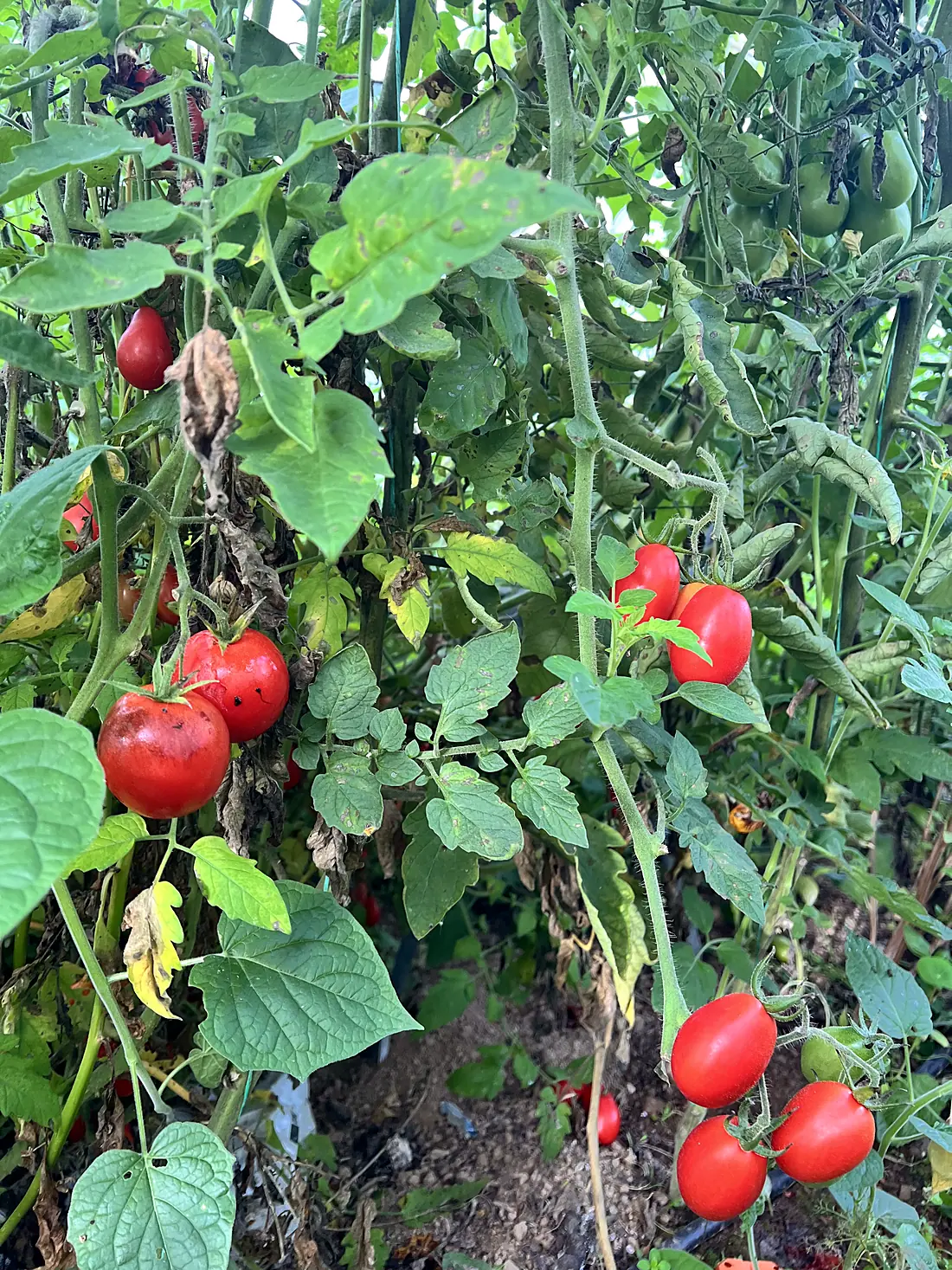
Pick tomatoes that are well coloured and slightly soft to the touch, ideally twice a week in high season. Heritage varieties often have thin skins and split easily after heavy rain or overgenerous watering: it is better to pick them a little early than to find them burst. Some, like the Noire de Crimée or the Cœur de bœuf, keep a green collar even when ripe: go by the colour of the rest of the fruit and its softness.
At the end of the season, when the nights turn cooler, pick the last fruit that are still green but well formed. They finish ripening indoors, in a warm place.
Saving tomato seeds, step by step
It is the most satisfying act of self-sufficiency: with a single tomato, you have seeds for years. Only from open-pollinated varieties, never from an F1.
- Choose the plants. During the season, spot the healthy, vigorous plants that produce well and whose fruit is true to the variety. To keep diversity, take fruit from several plants (seed producers advise 6 to 12 plants).
- Choose the fruit. Fully ripe, good to eat but not rotten, ideally from the first or second truss.
- Limit crossing. It is rare, but big fleshy tomatoes often have double flowers, which cross more easily. To be on the safe side, the advice is to space varieties about 3 m apart, and 9 to 12 m for those whose pistil sticks out of the flower. Nectar-rich flowers around the greenhouse draw the bees elsewhere.
- Extract. Cut the tomato in half and scoop the seeds with their gel into a glass jar, with a little pulp. Eat the rest!
- Ferment. Each seed is surrounded by a gel coating that stops it from germinating. Leave the jar for 2 to 3 days at room temperature: a white film forms on the surface, which is normal. Do not go beyond a few days.
- Rinse and sort. Add water, stir and leave to settle: the good seeds sink to the bottom. Pour off the water, the film and the seeds that float. Rinse in a fine sieve until they are clean.
- Dry. Spread them out for a few days in a dry, airy, shady place, on a plate or in a coffee filter (they do not stick to it). They must be completely dry: otherwise, they go mouldy.
- Store. In a jar or an envelope, in a dry, cool, dark place, with the name of the variety and the year. Tomato seeds keep their ability to germinate for about 4 to 6 years. Before sowing an old batch, do a test: twenty or so seeds in damp compost, and count how many germinate.
Three simple recipes with tomatoes from the greenhouse
Late-summer tomato sauce
Ingredients: 3 kg of very ripe tomatoes (Cornue des Andes and cœur de bœuf are perfect, not too juicy), 2 onions, 3 cloves of garlic, olive oil, thyme, a bay leaf, salt and pepper. Gently fry the sliced onion in the oil, add the garlic, then the chopped tomatoes and the herbs. Simmer uncovered for 45 minutes to 1 hour, stirring from time to time, until the sauce thickens. Pass through a food mill to remove the skins and seeds. It freezes very well in portions.
Tomato and mustard tart
Shortcrust pastry, 2 heaped tablespoons of mustard, 4 to 5 tomatoes of different colours (this is where heritage varieties really shine), 100 g of grated cheese, olive oil, thyme or basil. Line a tin with the pastry, prick it, spread the mustard over it and scatter half the cheese. Arrange the sliced tomatoes so that they overlap, season with salt and pepper, add the rest of the cheese, the herbs and a drizzle of oil. Bake for 30 to 35 minutes at 200 °C. Slice juicy tomatoes a little in advance and let them drain: the pastry will stay crisp.
Bottled tomatoes
To enjoy the harvest in winter. Dip the tomatoes in boiling water for 30 seconds, then in cold water: the skin comes off by itself. Cut them into quarters and pack them into clean, scalded jars with new seals. Add an acid : tomatoes are on the borderline of the acidity that protects against botulism, and health authorities recommend lemon juice or vinegar. The American reference guide (NCHFP) gives 1 tablespoon of bottled lemon juice, whose acidity is consistent, for a jar of about 50 cl, and 2 tablespoons for a litre. Close the jars, then sterilise them in a boiling water bath following the time given by the maker of your jars or by a tried and tested recipe, never shortening it. A jar that opens without a sound, or whose contents smell bad, must be thrown away.
Tomatoes and the farm
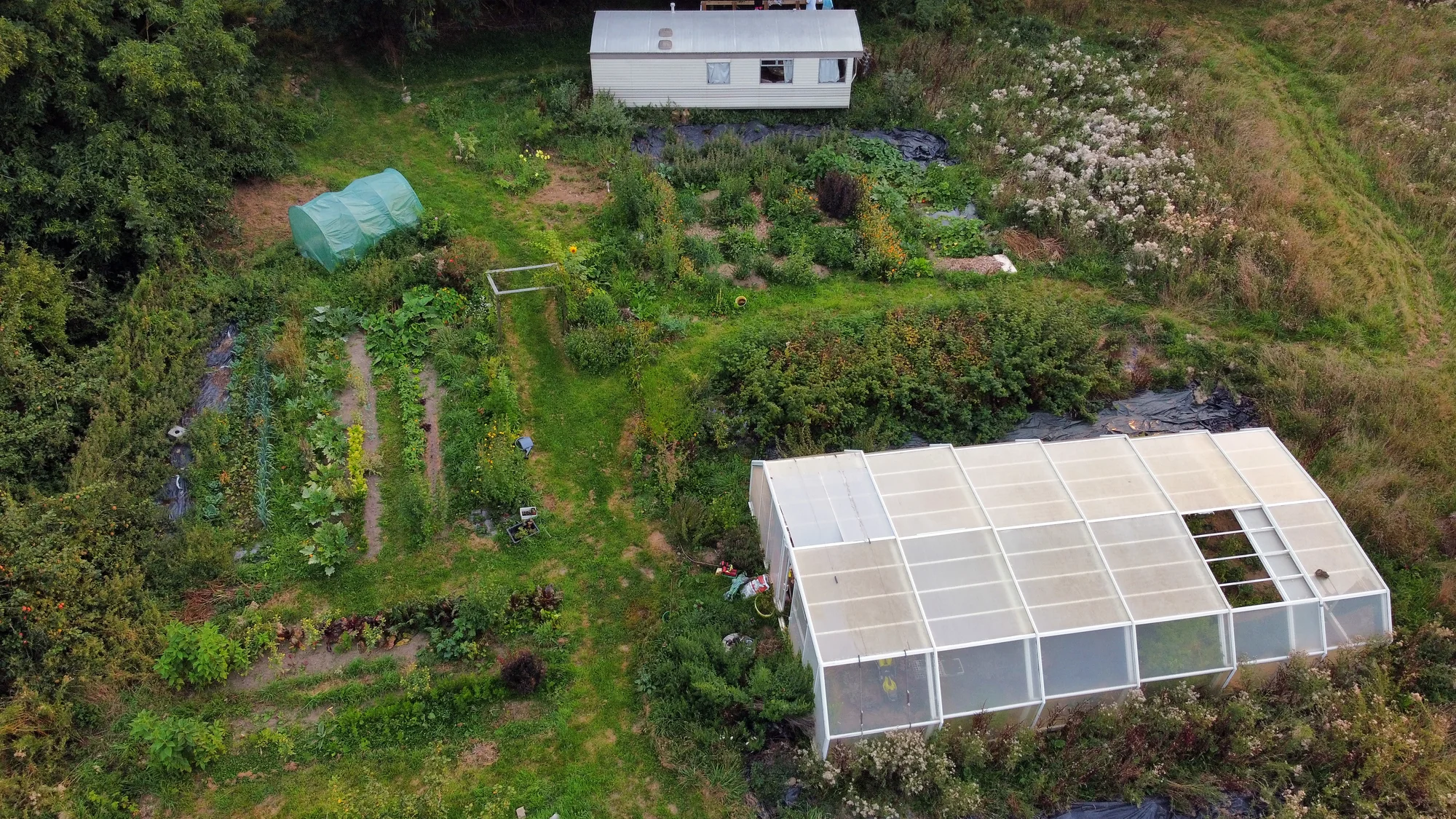
Since we arrived in 2019, we have planted more than 3,000 trees and seen the birds, insects and hedgehogs come back. Today the farm has its vegetable garden, its greenhouse and its orchard. The greenhouse tomatoes are not sold: like the rest of what we grow, they go on our own table, as part of our search for food self-sufficiency. To meet the donkeys, the sheep, the hens and the rest of the farm, go to the page the farm.
Practical info
- The campsite is open from 1 March to 1 November, in Cerisy-la-Forêt (Manche), between Saint-Lô and Bayeux. Out of season, from 1 October to 31 March, stays of at least 15 nights on request in the kota, the tiny house and the yurts.
- Without a car: the nearest station is Lison, 11 km away, on the Caen-Cherbourg line. The Cycling & hiking package, for those arriving by bike or on foot, costs less. Our ride ideas are in Normandy by bike.
- All our accommodation and prices are on the accommodationpage. A question? Write to us.
Frequently asked questions
Can you save the seeds of a tomato bought at the market?
Yes, if it is an open-pollinated variety and you know its name. If it is an F1 hybrid, or an unknown tomato, the plants may be very different from the original fruit. Trying costs nothing, but do not count on the result.
Do you need a greenhouse to grow tomatoes in Normandy?
No, but it helps a lot. Outdoors, tomatoes are exposed to the rain, which encourages blight, and the season is shorter. A simple shelter that keeps the rain off the leaves already makes a big difference, as long as it is well ventilated.
Should you remove all the side shoots?
On indeterminate varieties, yes, to keep one or two stems and bigger fruit. On determinate varieties, no: their fruit forms on these shoots.
- GRAB (Groupe de recherche en agriculture biologique), C. Mazollier, Les variétés de tomate de type ancien, bilan des essais sous abris, 2010
- GAB/FRAB Bretagne network, Tomato technical sheet and Growing plants on the farm (CTIFL references)
- DRAAF Centre-Val de Loire / FREDON, Ecophyto plan, J'ai du mildiou dans mes tomates
- INRAE, Ephytia, tomato: biology and epidemiology of blight
- Semences buissonnières / DIYseeds (Longo Maï), producing your own tomato seeds ; FiBL, on-farm seed production
- Météo-France, De la fraîcheur aux saints de glace : est-ce toujours d'actualité ?
- Wikipedia: F1 hybrid, Tomato, Noire de Crimée, Green Zebra (in English)
- Santé publique France / sante.fr, Conserves maison : comment éviter le botulisme ? ; Health Canada, safety tips for home canning ; National Center for Home Food Preservation, canning tomatoes (in English)