
The campsite in the snow
In the Manche, snow falls only a few days a year, and settles even less often. These white mornings are a small event. Here is winter as it really is at the campsite and in the Normandy bocage, and how to make the most of it.
- Snow is rare in the Normandy bocage: at Caen-Carpiquet, Météo-France records an average of 12 days a year with snowfall, often just a few flakes that do not settle.
- Winter here is mild and damp: an average of 5.6 °C in January, and barely more than 8 hours of daylight around 21 December.
- The campsite is open to the public from 1 March to 1 November. From 1 October to 31 March, stays of at least 15 nights, on request, in the kota, the tiny house and the 3 yurts.
- In winter: Bayeux Cathedral (free entry), the Bayeux Christmas market from 11 to 23 December 2026, the flooded marshes and their birds, the Cerisy forest.
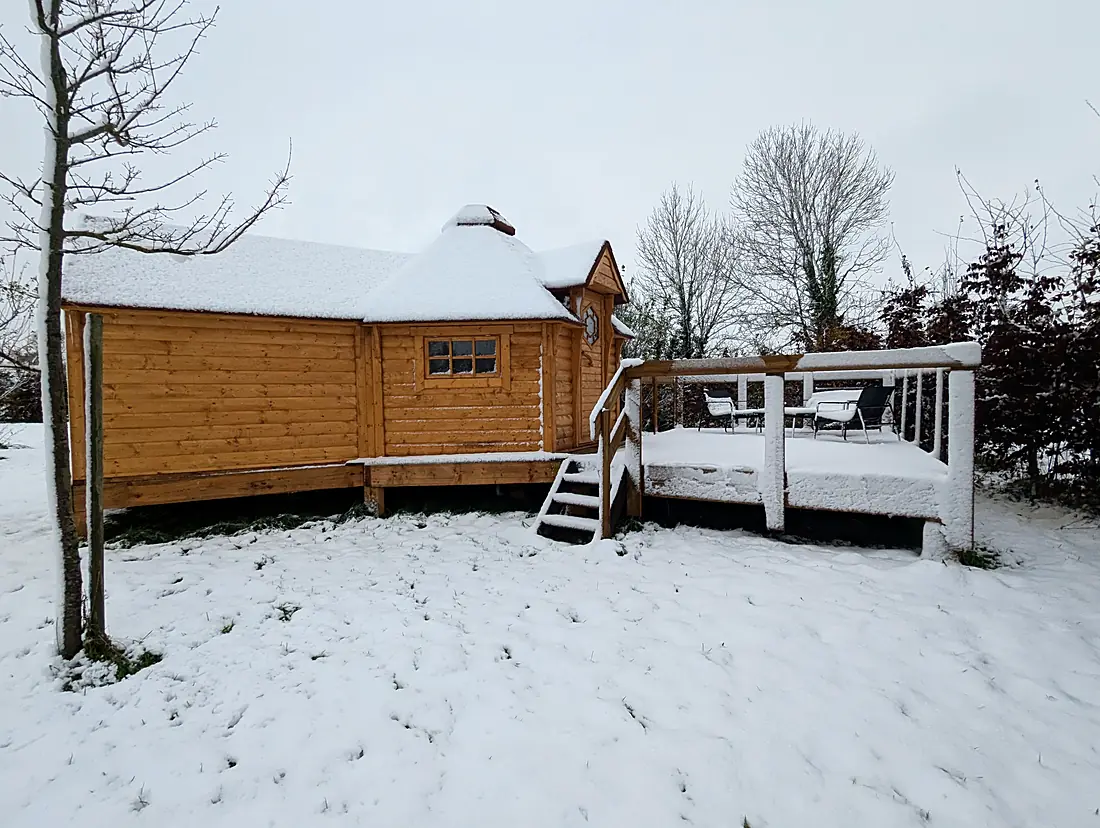
There are mornings when you open the door and the bocage has disappeared under white. The roofs of the accommodation are covered, so is the kota's terrace, and the only sound is the snow falling from the branches. Mornings like these are rare in the Manche. That is exactly what makes them precious.
In this article, we tell you about winter as it really is here in Cerisy-la-Forêt: a mild climate, short days, nature that never stops, and sometimes a little snow. With what you need to know to stay at the campsite out of season, and what you can do nearby in winter.
Snow in Normandy: rare, and therefore precious
Normandy has an oceanic climate. The nearby sea softens the winters: it is rarely very cold, and it rains more often than it snows. There is no weather station in Cerisy-la-Forêt. The nearest Météo-France reference station with full statistics is at Caen-Carpiquet, about forty kilometres to the east. Its figures give a good idea for the bocage.
How many days of snow a year?
Over the 1991-2020 period, Météo-France records at Caen-Carpiquet 12 days with snow a year on average. They are spread mainly over December (2.7 days), January (2.7), February (3.3) and March (1.6). There are still a few in November (0.9) and April (0.6).
Note that a “day with snow” does not mean a day under snow. It is a day when snow fell, even just a few flakes mixed with rain. Most of the time, it melts as it touches the ground. A real layer that settles, turning the meadows and roofs white, is much rarer. Some winters, there is none at all.
The closer you get to the sea, the rarer the cold. At Caen-Carpiquet, there are on average 28.7 days of frost a year (minimum temperature of 0 °C or below). On the coast, at Cherbourg, the Météo-France station recorded only 4.6 a year over the 1991-2014 period. The bocage, a little inland, therefore gets fairly regular ground frosts, but rarely severe cold.
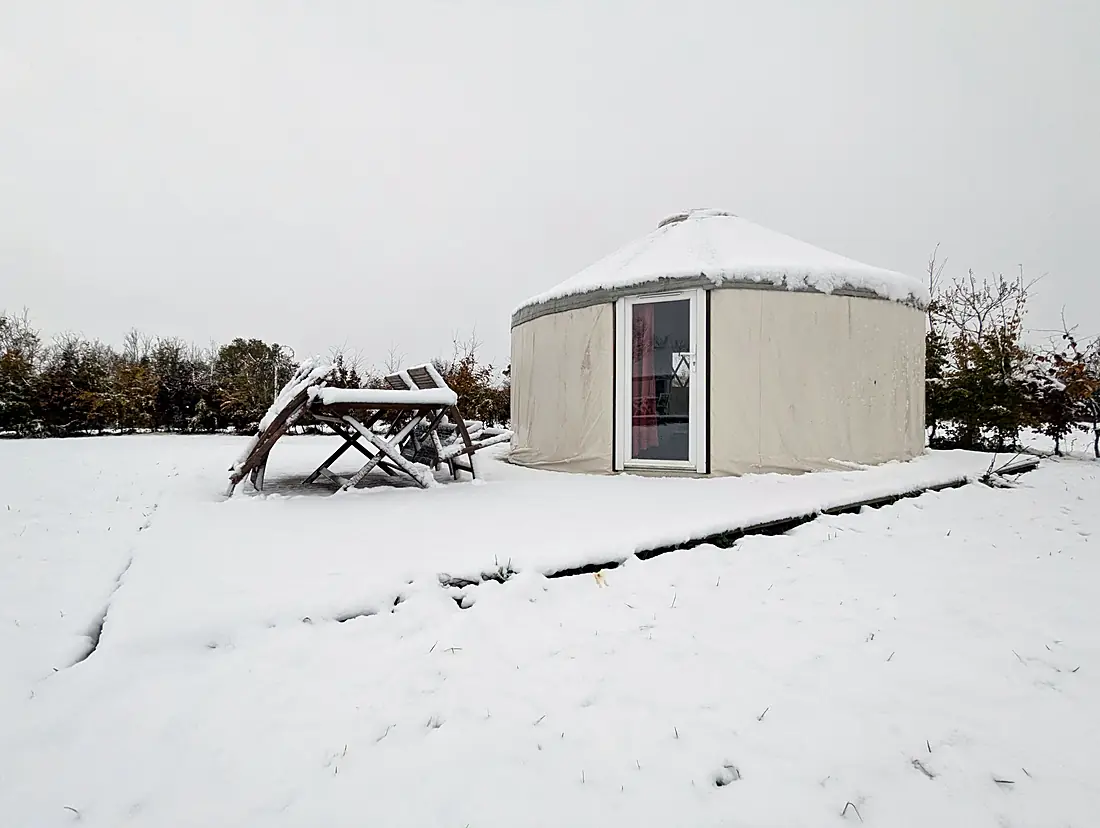
When the snow settles, the bocage changes its face
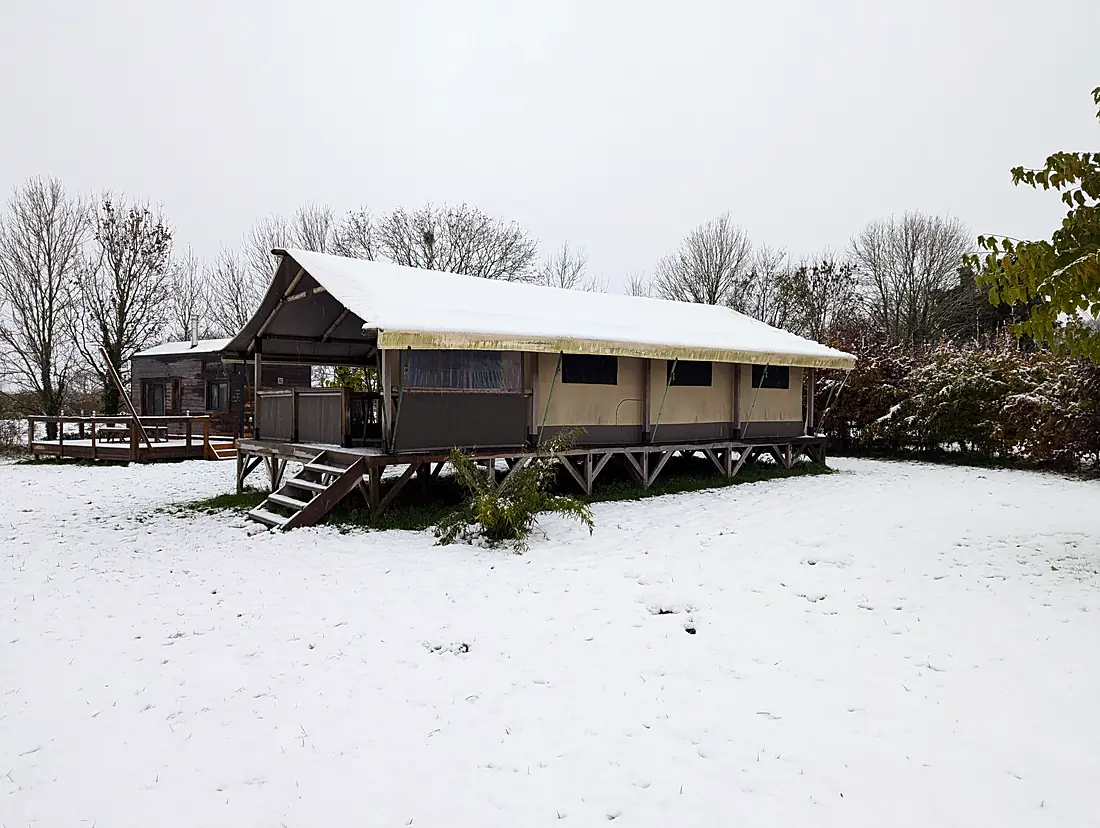
We look forward to these few white days almost like a celebration. The hedges draw dark lines across the meadows, the yurts turn into little snowballs and the Lodge Kenya wears an all-white roof. You can spot the tracks of the birds and small animals that crossed the meadow during the night. And usually, the snow does not last: a few hours, sometimes a day or two. You have to make the most of it straight away.
Winter in the Normandy bocage
A mild, damp climate and short days
At Caen-Carpiquet, the average January temperature is 5.6 °C, with an average of 8.3 °C in the afternoon and 2.9 °C at night. December is the wettest month (81 mm of rain on average, and 14 days with at least 1 mm). It is also the least sunny: 67 hours of sunshine over the whole month. Finally, the wind blows harder in winter than in summer.
The days are short. At the campsite, around 21 December, the sun rises at about 8.55 am and sets at about 5.05 pm: just over 8 hours of daylight, half as much as at the summer solstice. By early February, you have already gained more than an hour. This rhythm has its charm: long, cosy evenings and slow mornings.
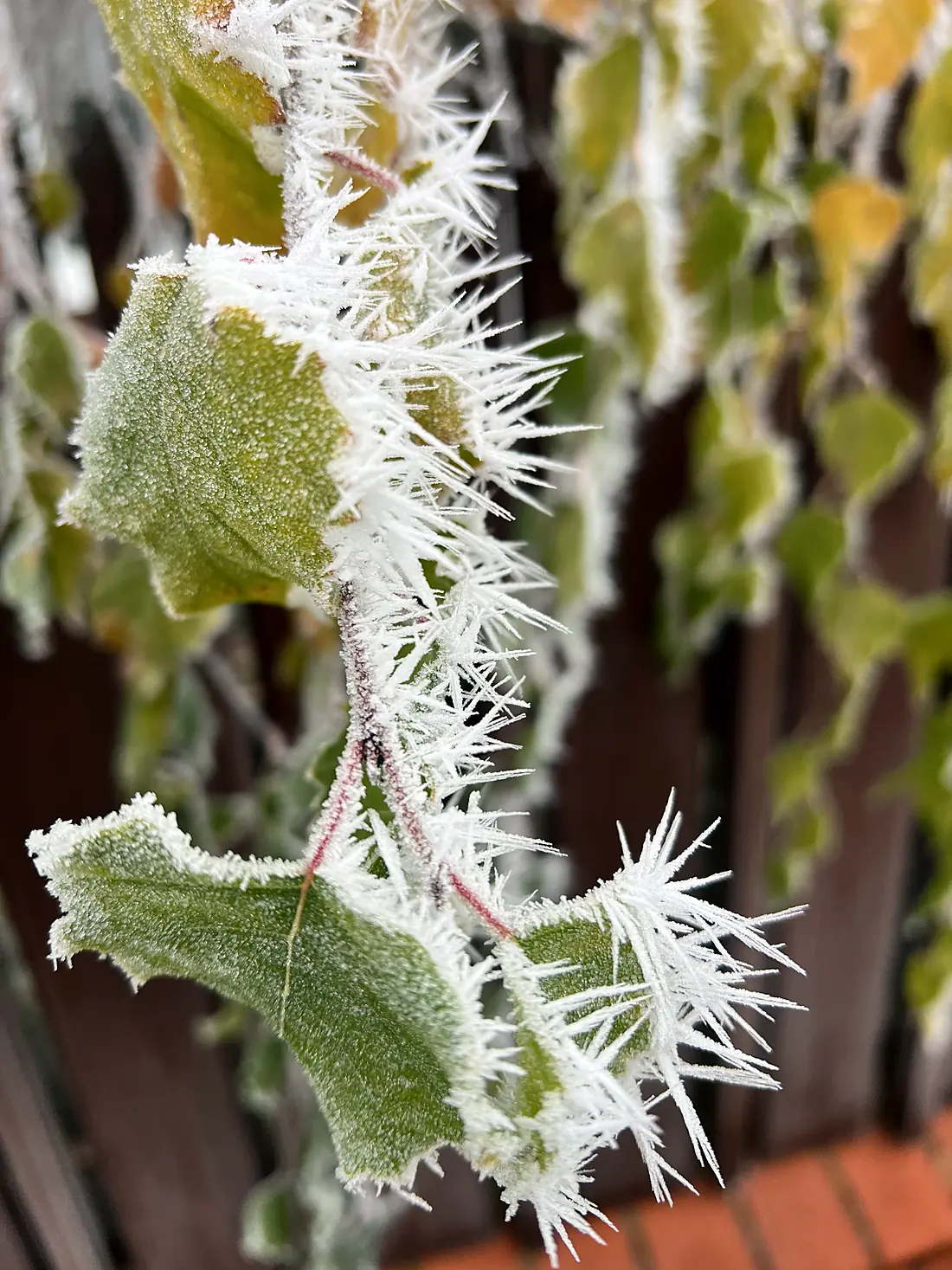
On frosty mornings, the frost works wonders. In cold, damp weather, it forms fine needles on the leaves, grasses and fences. It disappears as soon as the sun rises: go out early, camera in hand.
Winter birds
Winter is not a dead season for birds, quite the opposite. Some come from the north to spend the bad season with us. That is the case of the redwing, which nests only in northern Europe: in France, it can be seen only from October to March. It likes hedges and bocage areas, and feasts on berries and fallen fruit, such as apples. Look for its pale eyebrow and its rusty-red flanks.
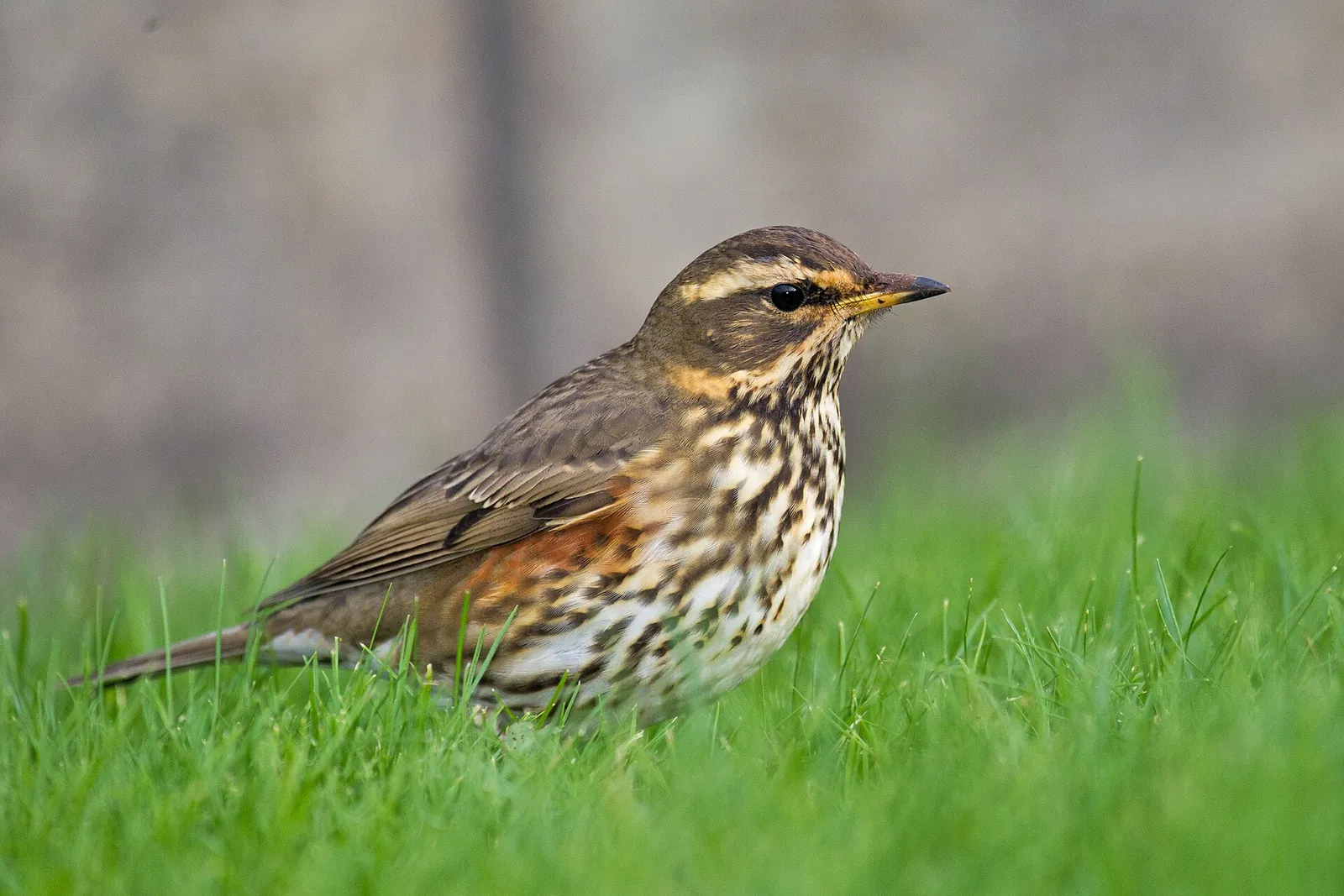
On the farm, biodiversity returns year after year. The more than 3,000 trees we have planted since we arrived are gradually becoming shelters for birds. In winter, when the branches are bare, it is the best time to watch them.
The white marshes
With the first autumn rains, the rivers overflow into the valley floors of the Cotentin and Bessin marshes. This is what is called the white marshes, which reach their peak in the depths of winter. The Regional Nature Park reports teal, shoveler, common snipe, lapwing, grey heron and white stork there. The Aure valley, near Trévières (about 26 min by car (23 km)), is part of these marshes. To go further, the Maison du Parc in Saint-Côme-du-Mont (about 35 min by car (36 km)) has leaflets telling you where to see the white marshes and the birds.
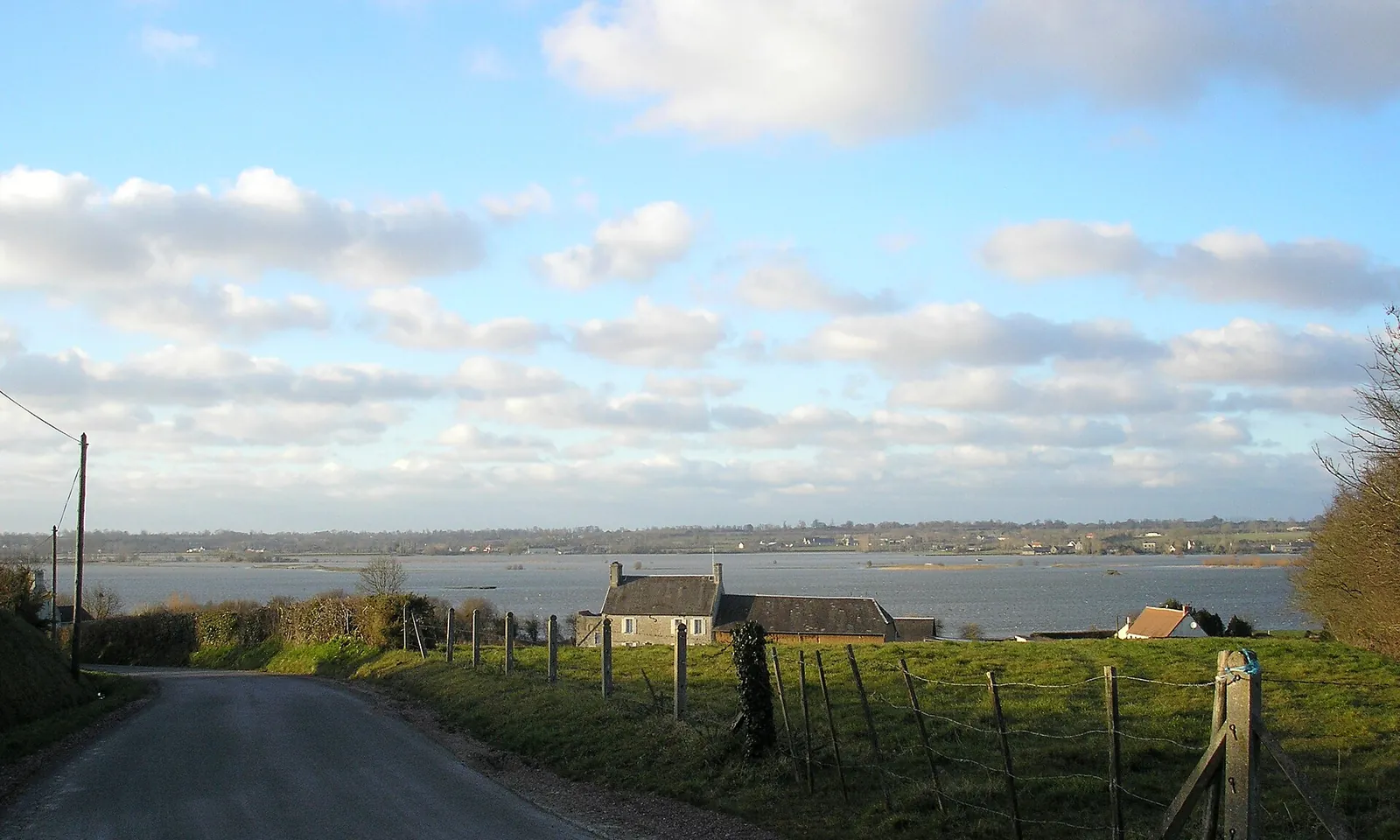
The Cerisy forest in winter
The Cerisy state forest, just over 2,100 hectares of beech wood classified as a national nature reserve, begins very close to the village. In winter, without the leaves, the light reaches the ground and you can see far between the grey beech trunks. It is a different forest from the summer one, calmer and more graphic. We describe it in detail in our article on the abbey, the forest and the Château de Balleroy.
Important: from October to February, it is the hunting season. The Isigny-Omaha tourist office strongly advises against walking in the Cerisy forest on Thursdays (driven-hunt day). On the other days of the week, the hunting that takes place poses no danger to walkers, but wear brightly coloured clothing. Stay on the waymarked paths: they are the only safe ones. And bring boots, the paths are often muddy in winter.
Staying at the campsite in winter
The campsite is open to the public from 1 March to 1 November. From November to February, it is closed to the public. But in winter, we welcome long off-season stays:
- When? From 1 October to 31 March.
- How long? 15 nights minimum.
- How? On request only: write to us or call us via our page contact.
- Where to stay? Only in the kota, the tiny house and the 3 yurts (the 27 m² yurt, the 17 m² yurt and the Wooden yurt).
For cold nights, the Finnish kota is our best-suited accommodation: it is insulated and heated. For 2 to 4 people, it is a wooden cocoon where you feel good when it is freezing outside. For the other accommodation, tell us about your dates and your needs: we will tell you what suits your stay best. All the information is on our page off-season and residents.
A winter stay of two weeks or more is a chance to experience the bocage differently: no crowds, living to the rhythm of the short days, with the farm close by. Socrate and Vénus the donkeys, Momo the little billy goat, the sheep and the poultry are waiting for you: meet them on the page the farm.
What to do around the campsite in winter
Bayeux, its cathedral and its Christmas market
About 27 min by car (25 km) away, Bayeux stays lively all winter. The Notre-Dame Cathedral is open free of charge all year round, from 10 am to 6 pm in winter (from 2 November to 12 April). The Memorial Museum of the Battle of Normandy is open from 10 am to 12.30 pm and from 2 pm to 6 pm from October to April. It is closed on the afternoon of 24 December, on 25 December, on the afternoon of 31 December and on 1 January, as well as for two weeks in January (from 5 to 18 January in 2026): check the 2027 dates before you come.
Good to know: the Bayeux Tapestry is on display at the British Museum in London until 11 July 2027, and its museum in Bayeux is being renovated. In Bayeux, the exhibition “De lin et de laine” tells its story until 19 September 2027. All the details are in our article on Bayeux, the marshes and the flavours of the Bessin.
The Bayeux Christmas market is held from 11 to 23 December 2026, in old Bayeux, from the Place de la Liberté to the Rue Léonard-Lambert-Leforestier. According to the town, it opens in the afternoon and evening: from 2 pm or 4 pm depending on the day, until 8 pm or 9 pm. Local and craft products on offer.
Christmas in Saint-Lô and Caen
In Saint-Lô (about 20 min by car (18 km)), the town puts on the “Saint-Lô fête Noël” programme over the festive season. In 2026, the Fête de l'hiver, a night-time bike parade, sets off from the square on Sunday 20 December at 5.30 pm. The full programme is published by the town and by Normandie Tourisme.
In Caen (about 44 min by car (48 km)), the big Christmas market has for some years been held on the Place de la République and the Boulevard Maréchal-Leclerc, from late November to late December. The 2026 dates had not yet been confirmed by the city at the time of writing: check the City of Caen website before you set off.
The D-Day beaches, in peace and quiet
Far from the summer crowds and the D-Day Festival, winter is a good time to pay your respects at the sites of 6 June 1944. The American Cemetery at Colleville-sur-Mer (about 40 min by car (28 km)) is open every day from 9 am to 5 pm, except on 25 December and 1 January. Pointe du Hoc (about 43 min by car (39 km)) is open every day, from 9 am to 12.30 pm and from 1.30 pm to 5 pm from 1 October to 31 March, with restoration work until mid-2027. Wrap up well: the wind blows hard on the cliffs. Our full itinerary is in the article Visiting the D-Day beaches.
For the other events of the season, take a look at our events calendar and at our page around the campsite.
Our tips for winter
- Dress in layers: it is rarely very cold, but you feel the damp and the wind. A good waterproof is better than a ski jacket.
- Boots: forest paths, meadows and marsh edges are often waterlogged.
- A head torch: it is dark by 5 pm. Handy for short evening walks too.
- If it snows: check the Météo-France weather warnings before setting off. The little bocage roads can be slippery, and the snow often melts during the day: sometimes waiting a few hours is enough.
- In the forest: no walks on Thursdays from October to February, and brightly coloured clothing on the other days.
- For visits: fit them in between 10 am and 4 pm, when the light is at its best, and always check the winter opening times.
Frequently asked questions
Is the campsite open in winter?
The campsite is open to the public from 1 March to 1 November, and closed to the public from November to February. From 1 October to 31 March, we welcome stays of at least 15 nights on request, in the kota, the tiny house and the 3 yurts.
Is it cold in the kota?
The Finnish kota is insulated and has heating. It is our best-suited accommodation for chilly nights. Winter in Normandy is mild, but there is frost on some nights: expect a few dozen frosts a year inland.
Does it snow in Normandy?
Not much. At Caen-Carpiquet, Météo-France records an average of 12 days a year with snowfall (1991-2020 normals), most often from December to February. Snow that settles on the ground is much rarer, and some winters there is none at all.
When is the best time to see snow?
Statistically, February, then January and December. But nothing is ever guaranteed in an oceanic climate: come for the peace of winter, and think of snow as a gift.
Can you come just for a weekend in winter?
No: from 1 October to 31 March, stays are for at least 15 nights, on request. For a short stay, see you from 1 March.
- Météo-France, climate data sheet for Caen-Carpiquet (14137001), 1991-2020 statistics: FICHECLIM_14137001 ; Caen-Carpiquet normals
- Météo-France, climate data sheet for Cherbourg-Homet (50129001): FICHECLIM_50129001
- Oiseaux des jardins (LPO and the Muséum national d'Histoire naturelle), redwing fact sheet
- Marais du Cotentin et du Bessin Regional Nature Park, the white marshes
- Isigny-Omaha tourist office, Côté forêt 2025 (rules in the Cerisy forest, hunting season)
- Bayeux Bessin Tourisme, Bayeux Cathedral ; Bayeux museums, Musée Mémorial, practical information
- Town of Bayeux, 2026 Christmas market (letter of 30 April 2026)
- Normandie Tourisme, Saint-Lô fête Noël: Fête de l'hiver ; Caen Christmas markets (evous.fr, to be confirmed on caen.fr)
- American Battle Monuments Commission: Normandy American Cemetery, Pointe du Hoc
- Sunrise and sunset times calculated for the campsite's location (NOAA astronomical formulas), to within a few minutes.
- Travel times calculated from the campsite with OpenStreetMap (OSRM), given as a guide only.